Floss is the one place in the bathroom where “plastic-free” and “PFAS-free” turn out to be the same question. The floss that slides most effortlessly between tight teeth usually does so because it’s coated in or spun from PTFE — polytetrafluoroethylene, the exact fluoropolymer that makes a nonstick pan nonstick, and a member of the PFAS “forever chemical” family. You’re dragging it firmly against gum tissue once or twice a day. It’s worth understanding what that does and doesn’t mean.
What the research actually found
In 2019, researchers at the Silent Spring Institute published a peer-reviewed study looking at behaviors that track with PFAS levels in women’s blood. Flossing with Oral-B Glide stood out: women who used it had about 25% higher serum PFHxS — one of the PFAS compounds — than women who didn’t. The team also screened 18 floss products with a fluorine-detection technique and found fluorine in six of them, including every Glide product tested. It was the first direct evidence that floss can add to a person’s PFAS body burden.
Five years later, an EPA-certified lab commissioned by the consumer-testing site Mamavation tested 39 flosses for organic fluorine. Thirteen — a third of them — had detectable fluorine, and an Oral-B Glide product came in highest, at roughly a quarter fluorine by weight. Conventional nylon flosses and a number of silk and plant-fiber flosses came back non-detect.
The honest proportion
Here’s where we try not to overstate it. The per-use exposure from a strand of floss is modest — this is not the largest PFAS source in most people’s lives, and the broader nonstick-cookware story involves the same chemistry at far greater scale. What makes floss worth switching is not that it’s uniquely dangerous, but that it’s a real, repeated, and completely avoidable source. You use it daily, for decades, in direct tissue contact, and a natural-fiber alternative costs about the same and works just as well. When avoidance is that cheap, the size of the individual exposure matters less.
“We removed the Teflon” — read the fine print
In early 2026, Oral-B’s maker said it had reformulated Glide to drop PTFE in favor of a “micro-textured” fiber, and stated that none of its floss contains PFAS. The Silent Spring researchers whose work prompted the change welcomed it — and pointed out that this is company self-reporting that hasn’t been independently verified, with older PTFE stock still working through store shelves. That’s the recurring pattern with these claims: a reformulation is announced, the label changes, and independent confirmation lags by years. The practical response isn’t to track any one product’s current recipe. It’s to pick a fiber that can’t contain a fluoropolymer in the first place.
Three kinds of floss
It helps to sort the whole category into three buckets:
- PTFE-fiber floss — the “glide,” “comfort,” and “smooth-slide” monofilaments. This is the PFAS one.
- Nylon floss — the classic waxed thread. It’s petroleum plastic in your mouth, and it sheds like any synthetic, but it’s not PFAS.
- Plastic floss picks — a short nylon strand on a molded plastic handle, thrown away after one use. The problem here is single-use plastic volume.
A quick warning on the “eco” shelf: “bamboo,” “charcoal,” and “plant-based” floss are frequently nylon or bio-nylon (a castor-derived polyamide), not plant fiber — the marketing describes a coating or an additive, not the thread. And a genuinely eco-branded, genuinely PFAS-free floss can still be plastic: Cocofloss, for instance, tests clean for fluorine but is spun from recycled PET (polyester). It’s a fair “if you must buy a plastic floss, at least it isn’t PFAS” — but it’s not plastic-free.
What to floss with instead
The clean answer is a protein or plant fiber with a natural wax:
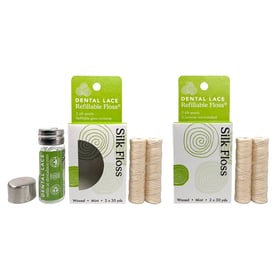
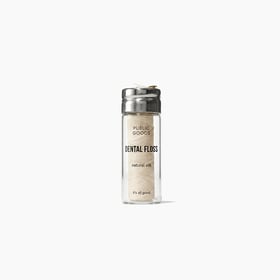
- Silk floss coated in candelilla or carnauba wax, ideally sold in a refillable glass vial with a steel cap. Silk cannot be a fluoropolymer by construction, so it sidesteps the PFAS question entirely, and it composts.
- If you avoid silk for ethical reasons, a PLA (corn) or bio-nylon floss is the honest middle ground: compostable and fossil-free, but still a polymer thread — better end-of-life, not a natural fiber. We’d rather say that plainly than call it plastic-free.
When you’re reading a package, two words settle most of it. If you see “glide,” “comfort,” “smooth,” “PTFE,” or “Teflon,” put it back. If you see silk or a named plant fiber, plus a natural wax, plus third-party PFAS testing, that’s the one — and the refillable glass vial is a nice bonus, not the point. The point is the thread.