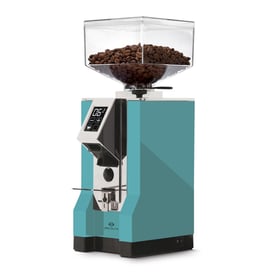
Eureka
Eureka is a good illustration of how little a metal exterior tells you. A Mignon looks and feels like a solid Italian machine, and the housing is metal — but on the Specialità, Silenzio and Zero the beans and grounds touch plastic at nearly every stage: plastic hopper, plastic lid, plastic exit chute, plastic or rubber-coated portafilter fork. Only the burrs and a small metal declumping vane are confirmed metal in the path.
The brand does differentiate on this, quietly. "Metallic Outlet Chute" appears as a feature bullet on the Mignon XL and nowhere else in the range — which is how you can tell the other models' chutes are not metal. The Zero is the one to know about at the budget end: everything upstream is still plastic, but it ships with a metal dosing cup rather than nothing at all.
How clear are their specs?
Eureka publishes burr diameter, burr material ("hardened steel"), RPM and wattage — and essentially nothing else. No product page or PDF manual names the hopper resin, the chute material, or the burr carrier. There is no BPA-free claim anywhere, and the CE declaration of conformity in the manuals covers only electrical, RoHS and WEEE directives — EC 1935/2004 on food-contact materials is conspicuously absent.
Products to avoid
Documented so you know what to skip — each still has a full breakdown and sources.