Niche
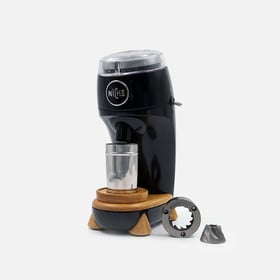
Niche never markets on materials, and the result is a grinder that is better than its reputation in one place and quietly worse in another. Beans go into an aluminium funnel and grounds land in a double-walled 304 stainless cup - both ends of the path are metal, which almost nothing else at this price manages. But the exit spout the grounds actually travel through is polymer, as is the lid and the grind-setting ring.
What is unusual here is where that information comes from. Niche's own site names two materials and stops. The detailed breakdown exists only in patent applications filed by Nicholson Design Consultants, the founder's design firm - documents written to describe the machine to patent examiners rather than to customers. They are the most honest materials disclosure this brand has produced, and they were never meant to be read as one.
There is a nice detail buried in them: Niche solved the static problem that plagues plastic grind paths not with a special coating but with wood. The patents report that making the stand and feet from wood made the electrostatic grounds hang-up "disappear" entirely.
How clear are their specs?
The public spec table lists two materials - "Body: Aluminium" and "Trim: Real oak" - and nothing about the grind path at all. There is no exploded diagram, no per-part material list, and no spares operation: the parts collection on the site is empty and points customers to an email address, while the accessories page 404s. No statement about food-contact plastics, BPA, or EC 1935/2004 appears anywhere in Niche's documentation; the only use of the phrase "food safe" is the silicone grease recommended for the adjustment threads. Country of manufacture is not stated either.