Best Non-Toxic Cutting Boards
Last reviewed September 2026
Wood, bamboo, and other boards to replace plastic cutting boards.
The short answer
Solid wood is the answer, and the main thing to know is that the popular "eco" board isn't one: Epicurean is a paper-and-phenolic-resin composite, and that binder is a cured plastic in the cutting surface. Teakhaus is the best all-round pick - naturally oily and water-resistant, so it needs less upkeep than maple - though teak's silica dulls knives very slightly faster. John Boos maple is the classic, and in end-grain it's the kindest surface to an edge, at the cost of regular oiling and strict hand-washing. If you want the feel of a plastic board without plastic, Sani-Tuff is solid natural rubber: self-healing, sandable, and very heavy.
Why plastic matters in cutting boards
Recent studies put plastic cutting boards among the largest direct microplastic sources in the kitchen - a knife physically shaves particles into your food with every cut, potentially tens of millions of particles per year. Unlike most categories there's no hidden component problem here; the swap is simple and the alternatives (wood) are arguably better tools.
What to look for in cutting boards
- Solid end-grain or edge-grain hardwood; check the glue (FDA-compliant / formaldehyde-free) on multi-piece boards
- One-piece boards have no glue at all
- Finish should be mineral oil / beeswax, not varnish
- Wood is naturally antimicrobial - the "plastic is more sanitary" belief is outdated
- Rubber boards (pro kitchens) are an interesting middle ground worth covering
- Solid laminated bamboo is a fine cheap option (plastic-free; just check the glue) - it is completely different from "bamboo fiber"/composite boards, which are melamine resin and excluded here
- Stainless steel and glass boards are zero-maintenance, dishwasher-safe, non-plastic surfaces - clean materially, but they dull knives faster than wood or rubber
Recommended cutting boards
Every product here we'd actually suggest — best-in-class picks first, then the rest by how plastic-free they are.
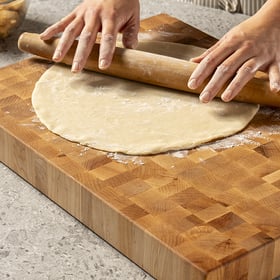
Maple Cutting Board / Butcher Block
Solid NSF-certified hard maple, edge- or end-grain - a bare wood board with only food-safe glue between staves. Zero plastic.
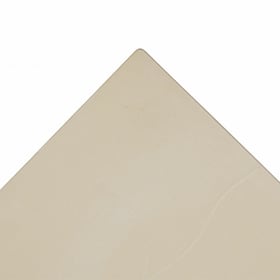
Sani-Tuff Natural Rubber Cutting Board
A commercial-kitchen board made of natural rubber - the plastic-free way to get a "plastic-like" board that's gentle on knives, sandable, and self-healing.
Teak Edge-Grain Cutting Board
Solid FSC-certified teak - a naturally oily, water-resistant, antimicrobial hardwood. Bare wood, no plastic, and lower-maintenance than maple.
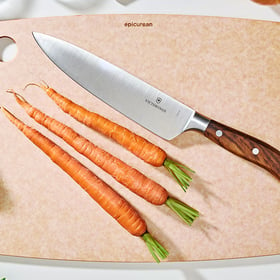
Cutting Board (Richlite)
The popular "eco" board is a paper-and-phenolic-resin composite - the binder is a cured plastic, so solid wood is still the cleaner plastic-free pick.
| Product | Rating | Touches your food | Price | Made in |
|---|---|---|---|---|
 John Boos Maple Cutting Board / Butcher Block Best Classic / Best for Knives (end-grain) John Boos Maple Cutting Board / Butcher Block Best Classic / Best for Knives (end-grain) | Wood | $$$ | USA | |
 NoTrax (Sani-Tuff) Sani-Tuff Natural Rubber Cutting Board Best Plastic Alternative (rubber) NoTrax (Sani-Tuff) Sani-Tuff Natural Rubber Cutting Board Best Plastic Alternative (rubber) | Natural Rubber / Latex | $$$ | USA | |
 Teakhaus Teak Edge-Grain Cutting Board Best Overall Teakhaus Teak Edge-Grain Cutting Board Best Overall | Wood | $ | — | |
 Epicurean Cutting Board (Richlite) Most Durable / Dishwasher-Safe (with caveats) Epicurean Cutting Board (Richlite) Most Durable / Dishwasher-Safe (with caveats) | Phenolic Resin | $ | USA |
Cutting boards to avoid
Popular options that look plastic-free but aren't — and whole categories worth skipping.
OXO Good Grips Utility Cutting Board
A plastic cutting surface sheds microplastics into food with every cut - the exact thing this category replaces. See the cutting-boards pick, the Teakhaus edge-grain teak board (or the John Boos maple board for end-grain).
"Bamboo fiber" / composite boards
Solid laminated bamboo boards are fine (plastic-free, though check the glue). But boards labeled "bamboo fiber" or "bamboo composite" are bamboo powder bound in melamine-formaldehyde resin - a plastic product, banned for food contact in the EU. Read the fine print.
Material reBoard and other recycled-plastic boards
Marketed as sustainable because the plastic is recycled - but it is still a plastic surface you cut on, so it sheds microplastics into food like any other plastic board. Recycled plastic solves a waste problem, not the food-contact one.
Common questions about cutting boards
Is there a fully plastic-free option for cutting boards?
Yes. Of the 4 cutting boards we recommend, 3 rate as fully plastic-free, with no plastic and no silicone anywhere in the product: John Boos Maple Cutting Board / Butcher Block, NoTrax (Sani-Tuff) Sani-Tuff Natural Rubber Cutting Board and Teakhaus Teak Edge-Grain Cutting Board.
Which cutting boards do you recommend most?
Of the 4 cutting boards we recommend, John Boos Maple Cutting Board / Butcher Block takes Best Classic / Best for Knives (end-grain), NoTrax (Sani-Tuff) Sani-Tuff Natural Rubber Cutting Board takes Best Plastic Alternative (rubber) and Teakhaus Teak Edge-Grain Cutting Board takes Best Overall.
Which cutting boards should you avoid?
Among the cutting boards we have reviewed, we do not recommend OXO Good Grips Utility Cutting Board. We also suggest skipping "Bamboo fiber" / composite boards and Material reBoard and other recycled-plastic boards.
Related:Food Storage Containers