Every wash, synthetic clothes shed tiny fibers — and because polyester, nylon, and acrylic are plastics, those fibers are microplastic. It’s one of the largest routes plastic takes into waterways. The good news, and the point of this piece, is that the things that reduce it most aren’t gadgets. They’re which clothes you own and how you wash and dry them. A companion article covers the capture devices; this one is about everything upstream of them.
First, an honesty note about the numbers
You’ll see a famous figure: a single synthetic wash load sheds around 700,000 fibers. That’s from Napper & Thompson’s 2016 study (specifically its acrylic sweater). But across studies the counts run from under 100,000 to over six million per load — not because washing varies that much, but because labs measure differently (some count fibers directly, others weigh the mass and back-calculate an assumed count). So treat any single number as order-of-magnitude, not precise. What’s far more reliable is the relative picture: which fabric, and which wash settings, shed more or less. That’s what’s actually actionable.
Which fabrics shed the most
Fabric is the single biggest factor — bigger than any wash setting.
- Acrylic and 100% polyester shed the most. In Napper & Thompson’s testing, acrylic was the worst, then polyester.
- Blends shed far less. A polyester-cotton blend shed roughly 80% fewer fibers than acrylic — the added cotton and higher tensile strength mean fewer pills break off.
- Construction matters, messily. Tightly woven or knit fabrics tend to shed less than loose, fuzzy ones like fleece — but the studies genuinely disagree on the details (one found woven polyester shed more than knit), because yarn twist, hairiness, and finishing all interact. “Tighter and smoother sheds less” is a fair rule of thumb, not a law.
One honest complication worth keeping in view: natural fibers shed too. Cotton and rayon actually shed as much or more by mass than polyester — and in real mixed household loads, most of the fibers shed are natural, simply because most wardrobes are mostly cotton. The difference that matters is what happens next: cotton and rayon biodegrade by roughly 60-76% in water, while polyester is under 5%. So “shedding” isn’t the same as “microplastic” — the polymer is what makes it a persistent plastic problem, which is exactly why the fiber you choose matters more than the fact that all fabrics shed.
What actually reduces the plastic shedding
Here’s the honest hierarchy, ordered by how much it helps and how solid the evidence is.
1. Own fewer synthetics (strongest lever, strongest evidence). Since fabric type dominates, the biggest reduction comes from buying natural fibers and tightly-constructed fabrics over cheap acrylic and loose fleece. This is the same logic as building a plastic-free wardrobe from the clothes that touch you most.
2. Wash less often. No study needs to prove this — fewer cycles means fewer shedding events, with no downside. Spot-clean and air out instead of default-washing.
3. Run full loads, skip “delicate,” and wash cold and short. This is where the mechanism is best understood: water volume drives shedding, not spin speed. Kelly et al. showed delicate cycles — which use more water — shed more, not less. Lant et al. found full loads (3.5-6 kg) shed about half the microfiber per kilogram that small loads did, and a cold, short cycle cut shedding ~30%. A caveat for accuracy: that ~30% bundles cold and short together, and a 10-degree temperature change on its own is small and inconsistent between studies — the real levers are water volume and less time tumbling, which “full, cold, express” delivers.
4. Air-dry when you can. Tumble drying is a separate pathway that vents fibers straight to outdoor air, bypassing wastewater entirely — measured drifting up to ~9 m from a dryer vent. Honest caveat: the lint trap catches most of it, so a dryer’s contribution beyond the trap is real but smaller than the wash’s contribution to water. Air-drying removes the pathway and is gentler on clothes.
5. Front-loader over top-loader; liquid over powder. A top-load machine’s central agitator is harsh — one study measured up to ~7x more shedding than a front-loader. Powder detergent’s abrasive builder particles scrub off more fiber than liquid. Both are single-study findings: the direction is trustworthy, the exact size isn’t, and neither is worth buying a new machine over — just useful when you already have the choice.
6. Skip the “use fabric softener to reduce shedding” advice. One study found softener cut shedding ~35%; another found it often increased release. It’s unsettled, and softener has its own downsides, so we don’t recommend it as a microfiber strategy.
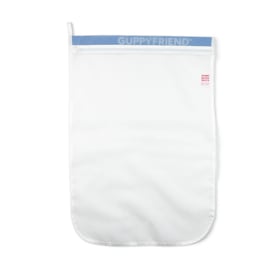
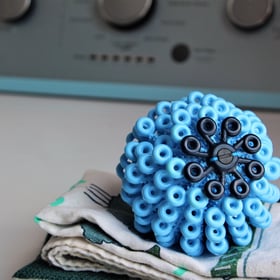
7. Then, if you want, a capture device. A washing-machine filter, a Guppyfriend bag, or a Cora Ball catches a share of what’s still shed. We put it last on purpose: it’s a real second line of defense, but it works downstream of every choice above. The devices — and how much each actually captures — are the subject of the companion article.
The honest bottom line
The directions here are well-supported; the precise magnitudes and how they add up are not, because the studies use incompatible methods. But you don’t need a precise fiber budget to act. The highest-leverage moves are the least technological: choose natural and tightly-woven fabrics, wash less, wash full and cold, and air-dry. A capture device is a worthwhile add-on once you’ve done those — not a substitute for them.