No product category generates more confused questions than nonstick cookware, because the marketing runs on acronyms most shoppers can’t parse. “PFOA-free!” sounds like the problem was solved. It wasn’t — the label is answering a question nobody asked anymore. Here’s the whole picture.
The cast of characters
- PFAS — the family: thousands of synthetic chemicals built on carbon–fluorine bonds, the strongest single bond in organic chemistry. That strength is the whole story: nothing in nature breaks it, so PFAS persist essentially forever in water, soil, and blood.
- PTFE (Teflon) — the nonstick coating itself. A PFAS, but an unusual one: it’s a huge, solid polymer, too big to be absorbed the way the small troublemakers are.
- PFOA — a small PFAS formerly used to manufacture PTFE. This is the chemical behind the DuPont lawsuits and the movie: linked to kidney and bladder cancer in exposed workers and contaminated communities, now in the blood of nearly everyone on earth. Phased out of cookware production by 2013–2015.
- GenX and friends — what replaced PFOA in manufacturing: structurally similar short-chain PFAS whose own safety record is, so far, following a familiar unhappy arc. The regrettable-substitution pattern from our myths article applies here verbatim.
So when a pan says “PFOA-free”: every pan is. It’s been the law of the land for a decade. The label tells you nothing about the coating on the pan, which is still PTFE — a PFAS — made with PFOA’s replacements.
Honest question 1: is cooking on PTFE dangerous?
Less than you’d think, at normal temperatures. Intact PTFE is genuinely inert in the pan — the American Cancer Society’s assessment is that Teflon cookware itself is not a meaningful cancer exposure, and swallowed flakes mostly pass through. If you own a nonstick pan in good condition and use it gently, the per-meal exposure case against it is weak. We’d rather say that plainly than exaggerate.
The two real problems:
- Overheating. Above roughly 260°C / 500°F, PTFE starts decomposing into fluorinated fumes that cause “polymer fume fever” in humans — flu-like illness hours later — and kill pet birds outright (the case reports are grim and consistent). An empty pan preheating on high can pass 260°C in a couple of minutes. Searing, broiling, wok cooking, and absent-minded preheating all live near or past the line. A safety margin that thin, on a tool you use distracted and daily, is bad design.
- Wear. Coatings scratch and thin; scratched pans shed micro- and nanoplastic particles into food at rates that scale with damage. Every nonstick pan is a countdown — typical lifespan is two to five years, and its end state is a landfill object wrapped in forever chemicals.
Honest question 2: what about the environmental case?
This one is unambiguous. Even if the pan never harms you personally, PFAS manufacturing has contaminated drinking water for millions of people, the chemicals never degrade, and buying fluoropolymer products funds the pipeline. For a lot of readers this — not the fumes — is the actual reason to opt out, and it’s a good one.
What about “ceramic nonstick”?
Sol-gel coatings (GreenPan-style “ceramic”) are usually genuinely PTFE/PFAS-free — that part of the marketing checks out. The catch is durability: the slippery layer degrades with heat cycles and metal utensils, typically losing its nonstick in one to two years, and once it does you’re back on the replacement treadmill. It solves the chemical question and keeps the disposability problem. Reasonable as a transitional buy; not an endgame.
The same logic applies beyond pans — it’s why our small-appliances coverage (air fryers especially) is framed around coatings: an air fryer is frequently a PTFE-coated basket running hot, right at the temperatures where the margin gets thin.
What we’d actually cook on
The boring, century-old answers, all effectively nonstick once learned:
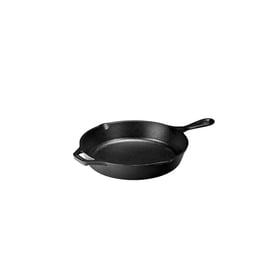
- Cast iron — needs seasoning, lasts generations, tolerates any heat.
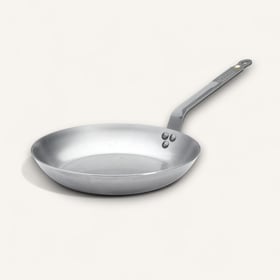
- Carbon steel — cast iron’s lighter, faster-heating sibling; the default pan of professional kitchens.
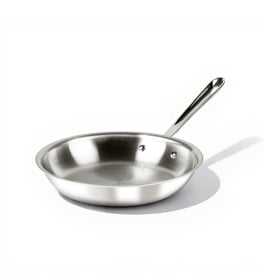
- Stainless steel — no seasoning, dishwasher-safe; eggs take technique (heat control + fat), everything else is easy.
- Enameled cast iron — glass surface, no seasoning, great for acidic food.
The honest trade: you give up effortless eggs for the first month and get back pans that never expire, never fume, and never ask you to decode an acronym again.
The bottom line
“PFOA-free” is marketing for a decade-old regulation. PTFE at normal cooking temperatures is a modest personal risk with a thin overheating margin — and a certain environmental one. Ceramic coatings fix the chemistry but not the disposability. Cast iron, carbon steel, and stainless fix both, which is why they’re what our cookware picks are built from.