Best Non-Toxic Slow Cookers
Last reviewed July 2026
Crock-style slow cookers - where the contention is the glaze and the lid, not the housing.
The short answer
A conventional slow cooker asks you to pick which unknown you'd rather have: a glazed ceramic crock with a lead-and-cadmium question, or a coating. VitaClay sidesteps both with an unglazed Zisha clay pot and clay lid - no glaze, no coating, nothing plastic in the food path - though raw clay carries trace natural lead and testing found high lead in some non-food-contact metal parts. The 360 Cookware model is the all-stainless answer with no crock at all, at several times the price. The mainstream Crock-Pot is fine on materials, with only a plastic knob above the food. The Instant Pot is the multi-cooker compromise: all metal but a required silicone ring.
Why plastic matters in slow cookers
Slow cookers look clean on paper: food cooks in a ceramic (stoneware) crock under a glass lid, both inert. And for the most part they are - a properly formulated, fully-fired glaze on a reputable modern crock is essentially inert, and the brands worth buying publish third-party lead and cadmium testing below FDA and Prop 65 limits. The community view here is calmer than the alarm the topic sometimes gets, and we share it. Where the caution genuinely applies is the edges: cheap, unbranded, vintage, or artisanal crocks that publish no testing, and any crock whose glaze has chipped, are the real risk given food sits in them on heat for 8+ hours. The other material question is the lid: many have a plastic knob, and multicookers add a silicone gasket and plastic-lined lid in the steam path. So the things to actually check are glaze provenance and lid parts, not the appliance body.
What to look for in slow cookers
- Crock glaze with published third-party lead/cadmium testing (reputable brands provide it and a quality fired glaze is essentially inert; the real risk is cheap/vintage/artisanal unknowns and chipped glaze)
- Glass lid with a metal (not plastic) knob, or a knob that doesn't sit over the food
- Multicookers add a silicone sealing ring and plastic lid parts in the steam path - silicone-only at best
- An enameled cast iron dutch oven in a low oven is the fully controllable, coating-free alternative
Recommended slow cookers
Every product here we'd actually suggest — best-in-class picks first, then the rest by how plastic-free they are.
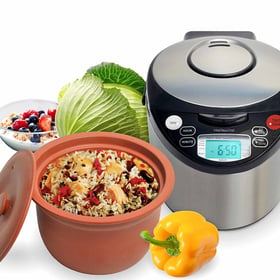
Smart Organic Clay Multicooker
Cooks in an unglazed natural Zisha clay pot with an unglazed clay lid - no glaze, no lead-glaze question, no coating and no plastic or silicone in the food path. The standout on materials, with one caveat about naturally occurring lead in the raw clay.
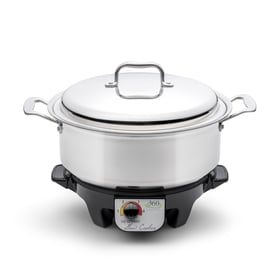
Stainless Steel Slow Cooker
An all-stainless slow cooker with no ceramic crock and no plastic or silicone lid parts - a clad-stainless stockpot on an electric base, sidestepping the glaze question entirely.
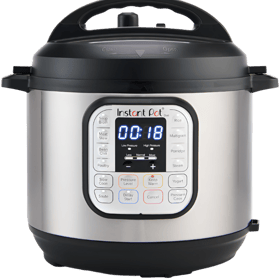
Duo Multi-Cooker
Food-grade 304 stainless inner pot with a stainless lid underside and steel anti-block shield - the only food/steam-contact non-metal is the silicone sealing ring, landing it at silicone-only.
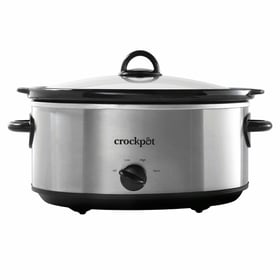
Manual Slow Cooker (SCV700)
Glazed stoneware crock the brand tests below FDA/Prop 65 lead-and-cadmium limits, under a glass lid - the only plastic is the lid knob, which sits over the food but never touches it.
| Product | Rating | Touches your food | Price | Made in |
|---|---|---|---|---|
 VitaClay Smart Organic Clay Multicooker Best Unglazed Clay VitaClay Smart Organic Clay Multicooker Best Unglazed Clay | Ceramic / Stoneware / Porcelain | $$$ | — | |
 360 Cookware Stainless Steel Slow Cooker Best Materials 360 Cookware Stainless Steel Slow Cooker Best Materials | Stainless Steel | $$$$ | USA | |
 Instant Pot Duo Multi-Cooker Best Multi-Cooker Instant Pot Duo Multi-Cooker Best Multi-Cooker | Silicone ·Stainless Steel ·Stainless Steel | $$$ | — | |
 Crock-Pot Manual Slow Cooker (SCV700) Best Mainstream Pick Crock-Pot Manual Slow Cooker (SCV700) Best Mainstream Pick | Ceramic / Stoneware / Porcelain ·Tempered Glass | $$ | — |
Slow cookers to avoid
Popular options that look plastic-free but aren't — and whole categories worth skipping.
Cheap/unbranded stoneware crocks
The glaze is the whole risk in this category and unbranded, vintage, or imported-artisanal crocks publish no lead/cadmium testing - exactly the pieces most likely to leach lead, especially once the glaze chips. Without a named, testable glaze claim we can't recommend them.
Nonstick-coated multicooker inserts (PTFE/ceramic-coated slow-cook pots)
Multicookers sold with a coated aluminum insert put a PTFE or ceramic nonstick coating directly in the food path - it wears out, can flake, and defeats the point when uncoated stainless or bare clay pots exist. Choose the stainless-insert version instead.
Common questions about slow cookers
Is there a fully plastic-free option for slow cookers?
Yes. Of the 4 slow cookers we recommend, 2 rate as fully plastic-free, with no plastic and no silicone anywhere in the product: VitaClay Smart Organic Clay Multicooker and 360 Cookware Stainless Steel Slow Cooker.
Which slow cookers do you recommend most?
Of the 4 slow cookers we recommend, VitaClay Smart Organic Clay Multicooker takes Best Unglazed Clay, 360 Cookware Stainless Steel Slow Cooker takes Best Materials and Instant Pot Duo Multi-Cooker takes Best Multi-Cooker.
Which slow cookers should you avoid?
We suggest skipping Cheap/unbranded stoneware crocks and Nonstick-coated multicooker inserts (PTFE/ceramic-coated slow-cook pots).
Related:Rice Cookers· Cookware