Best Burr Coffee Grinders (Plastic-Free)
Last reviewed September 2026
Motorized burr grinders - the side of the category where plastic is still the default. The burrs are steel on any real machine, but the hopper beans sit in, the chute they exit through, and the bin they land in are plastic on most grinders, including expensive metal-bodied ones. A small group of single-dose grinders now builds that whole path in metal.
The short answer
The genuinely plastic-free electric grinder is not shipping yet. SimplyGoodCoffee's brewer-maker has one on pre-order for September 2026 where beans touch only glass and steel; until it ships and someone verifies a production unit, treat it as a promise. Of what you can buy now, the Varia VS3 claims metal from hopper to catch cup, though no independent teardown has confirmed it, and the DF64V gen 3 is the better-documented choice - its maker publishes the anodised chute and steel declumper part by part, and only the silicone bellows hopper keeps it off a full-metal rating. Avoid the earlier DF64 gen 2, whose exit chute is plastic.
Why plastic matters in electric grinders
On an electric grinder the plastic is never the part you're looking at. The body can be cast aluminum and the burrs hardened steel while beans still start in a polycarbonate hopper, fall through an ABS chute, and land in a static-prone plastic bin - the exact three parts coffee actually touches. That's the standard build from the $150 Baratza up through $600 Italian espresso grinders.
What changed recently is the single-dose category. Dosing one shot at a time removes the bulk hopper entirely, and a handful of makers - Varia, Option-O, Mazzer, DF's newer generations - went the rest of the way and specified metal for the chute and catch too. Simply Good Coffee's glass-and-steel machine goes further still. These are real products you can buy, not compromises, which is why the electric answer is no longer just "get a hand grinder."
What to look for in electric grinders
- Three parts decide it - the hopper, the chute, and the catch bin - and a grinder can get two right and still run grounds through plastic
- A metal exterior tells you nothing - Eureka, Baratza and Fellow all build metal-looking machines with plastic hoppers, chutes and bins
- Read the chute, not just the hopper - it's the part makers are least likely to document, and where grounds actually exit
- Single-dose is the plastic-free path here - no bulk hopper means one less plastic part, and every all-metal grind path we found is a single-dose design
- Ask for a part-by-part list, not a marketing line - DF publishes the chute and declumper materials in its manual; most brands only say "stainless steel burrs" and stop
- The bellows or blower used to purge a single-dose chamber is usually silicone - that's a brief, cold contact and not the thing to worry about
- Small lift-out parts (a finger guard, an anti-popcorn lid) are where an otherwise all-metal grinder sneaks in polymer - and the ones that lift out are fixable
- Static is the practical argument for metal - grounds cling to a plastic bin, and the all-metal grinders answer it with grounded metal or ionization rather than a plastic-and-static compromise
Recommended electric grinders
Every product here we'd actually suggest — best-in-class picks first, then the rest by how plastic-free they are.
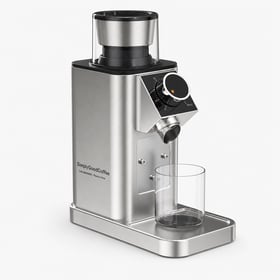
The Grinder (Plastic-Free)
The category-changer - an electric burr grinder where beans and grounds touch only glass and steel, no plastic or aluminum. Pre-order (ships Sept 2026), but it's the plastic-free electric grinder that hasn't existed until now.
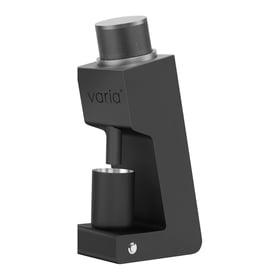
VS3
A single-dose electric grinder built around a claim almost no competitor makes - that coffee touches only metal from the hopper to the catch cup.
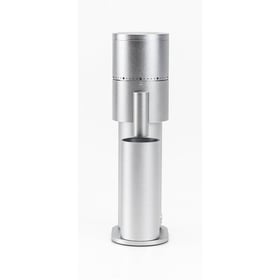
LAGOM mini 2
A palm-sized machined-aluminum electric grinder where the only non-metal part in the bean path is a small finger guard that lifts straight out.
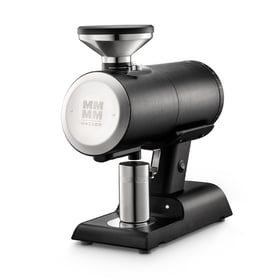
Philos
The only electric grinder we found that ships with a stainless steel hopper as standard - beans start in steel and grounds end in a steel canister.
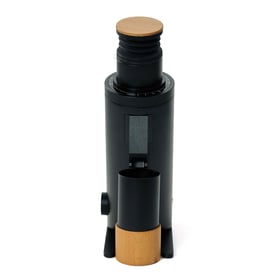
DF64V Gen 3
The generation where the plastic finally left the coffee path - an anodised aluminium chute and a stainless declumper, published part by part in the maker's own manual.
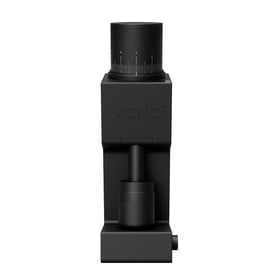
VS6
The bigger, faster sibling to the VS3, carrying the same all-metal coffee path plus ionization needles in the chute instead of a plastic-and-static compromise.
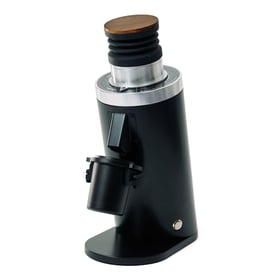
DF64 Gen 2
The grinder that made 64mm flat burrs affordable - beans land in silicone and grounds leave through a plastic chute, which the brand concedes in one sentence and nowhere else.
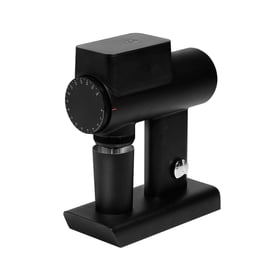
Sculptor 064S
An all-metal grind path with one plastic exception - the hopper beans land in first, on a grinder that otherwise gets the parts most makers get wrong right.
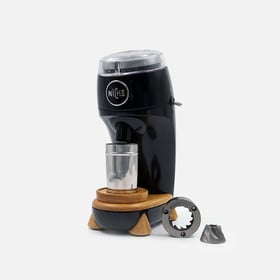
Zero
Beans start in an aluminium funnel and grounds land in a 304 stainless cup - but the spout they travel through in between is polymer, a fact only the founder's patent filings disclose.
| Product | Rating | Touches your food | Price | Made in |
|---|---|---|---|---|
 Simply Good Coffee The Grinder (Plastic-Free) Best Electric (Coming Soon) Simply Good Coffee The Grinder (Plastic-Free) Best Electric (Coming Soon) Coming soon | Borosilicate Glass ·Stainless Steel | $$$$ | — | |
 Varia VS3 Best Electric (Available Now) Varia VS3 Best Electric (Available Now) | Silicone ·Metal ·Stainless Steel ·Anodized Aluminum | $$$$ | China | |
 Option-O LAGOM mini 2 Best Compact Electric Option-O LAGOM mini 2 Best Compact Electric | ▲Better: Plastic-free | Plastic ·Anodized Aluminum ·Stainless Steel ·Metal | $$$$ | China |
 Mazzer Philos Best High-End Electric Mazzer Philos Best High-End Electric | ▲Better: No-contact plastic | Silicone ·Stainless Steel | $$$$ | Italy |
| Silicone ·Wood ·Anodized Aluminum ·Stainless Steel | $$$$ | China | ||
| Silicone ·Metal ·Stainless Steel ·Aluminum ·Anodized Aluminum | $$$$ | China | ||
| Plastic ·Silicone ·Wood ·Stainless Steel ·Aluminum | $$$$ | China | ||
| Polypropylene ·Metal ·Stainless Steel ·Aluminum | $$$$ | China | ||
| Plastic ·Aluminum ·Steel ·Stainless Steel | $$$$ | China |


Electric grinders to avoid
Popular options that look plastic-free but aren't — and whole categories worth skipping.
Eureka Mignon Specialità
The default sub-$600 espresso grinder recommendation, and a solid machine - but the beans and grounds touch plastic at every stage except the burrs. A metal Italian housing tells you nothing about the coffee path.
Fellow Opus
A stylish, well-reviewed electric grinder that people assume is a clean upgrade - but the hopper, the catch cups, and the body are plastic, so beans and grounds travel entirely through plastic. Its whole appeal (an anti-static ionizer) exists precisely because the grounds path is static-prone plastic. If you want to keep coffee out of plastic, a metal-bodied hand grinder does it and this doesn't.
Baratza Sette 270
Marketed on a short straight-through path where coffee falls from the burrs into the portafilter - but Baratza's own spec sheet says the construction material is ABS plastic, and the service manual has you pull a plastic chute off a plastic burr holder.
Baratza Encore
The default recommended home electric grinder, but the bean hopper and the grounds catch bin are plastic and the grounds path is plastic throughout - static and all. A fine grinder, not a plastic-free one.
Fellow Ode (Gen 2)
Premium single-dose electric grinder with an aluminum body and steel burrs, but Fellow's own materials line reads "Aluminum body, plastic load bin and base, stainless steel burrs" - so the bean load bin is plastic and beans enter the grind path through plastic despite the metal exterior.
Common questions about electric grinders
Is there a fully plastic-free option for electric grinders?
Yes. Of the 9 electric grinders we recommend, 1 rates as fully plastic-free, with no plastic and no silicone anywhere in the product: Simply Good Coffee The Grinder (Plastic-Free).
Which electric grinders do you recommend most?
Of the 9 electric grinders we recommend, Simply Good Coffee The Grinder (Plastic-Free) takes Best Electric (Coming Soon), Varia VS3 takes Best Electric (Available Now) and Option-O LAGOM mini 2 takes Best Compact Electric.
Which electric grinders should you avoid?
Among the electric grinders we have reviewed, we do not recommend Eureka Mignon Specialità, Fellow Opus and Baratza Sette 270. We also suggest skipping Baratza Encore and Fellow Ode (Gen 2).
Related:Hand Grinders